
NXP BAP64-02: A Comprehensive Overview of the Silicon PIN Diode for High-Frequency Switching and Attenuation
In the realm of high-frequency electronics, the ability to precisely control RF signals is paramount. The NXP BAP64-02 stands as a quintessential component engineered to meet this exacting demand. This silicon PIN diode is specifically designed for high-speed switching and precise attenuation applications, making it a cornerstone in the design of modern communication systems, from cellular infrastructure to sophisticated test and measurement equipment.
The fundamental operation of a PIN diode hinges on its unique semiconductor structure: a high-resistivity intrinsic (I) region sandwiched between P-type and N-type semiconductor materials. Under a zero- or reverse-bias condition, the I-region remains devoid of carriers, causing the diode to exhibit a very high impedance state, effectively acting as an open circuit or a small-valued capacitor. Conversely, when a forward bias is applied, charge carriers are injected into the I-region, drastically lowering its resistance and creating a very low impedance state. This drastic and rapid change in impedance, controllable by a simple DC bias, is the mechanism exploited for switching and attenuation.
The BAP64-02 distinguishes itself through a set of optimized characteristics tailored for RF performance. Its extremely low series resistance (Rs) in the forward-biased state, typically just a few ohms, ensures minimal insertion loss when the diode is "ON." This is critical for maintaining signal integrity in transmit/receive (T/R) switch modules. Equally important is its low capacitance (Ct) in the reverse-biased state, typically in the fraction of a picofarad range. This low off-state capacitance is vital for achieving high isolation between ports in a switch, preventing signal leakage. Furthermore, the diode boasts an exceptionally fast switching speed, enabling it to transition between states in nanoseconds. This speed is essential for applications like phased-array antennas and pulsed systems.
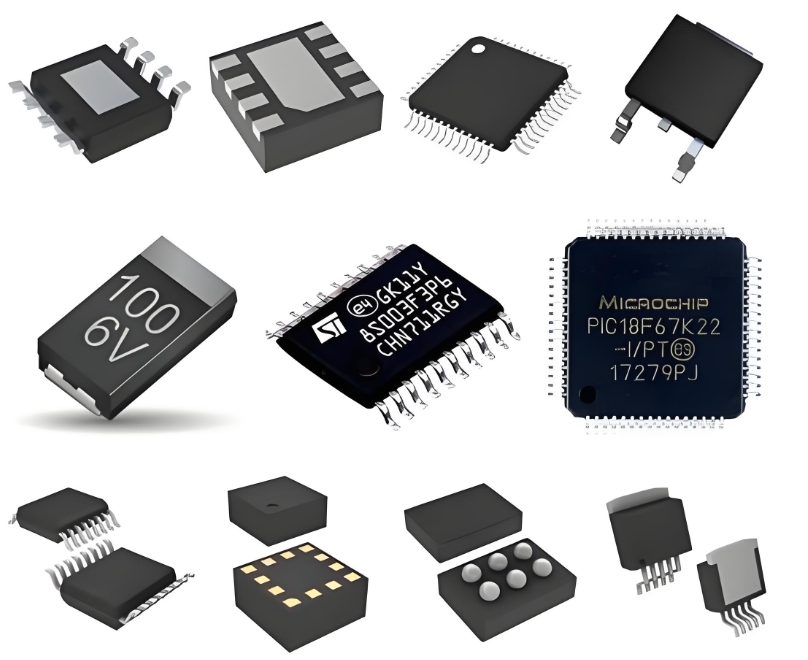
These characteristics make the BAP64-02 exceptionally versatile. Its primary application is in RF and microwave switching, where it is used to route signals between different paths, such as in antenna switches or filter banks. Secondly, it is a key component in voltage-controlled attenuators. By varying the forward bias current (and thus the resistance of the I-region), the diode can provide precise, linear-in-dB attenuation over a wide dynamic range. You will also find it in protection circuits, where it can shunt high-power signals away from sensitive receivers, and in phase shifters for beam-forming networks.
A key advantage of this specific device is its integration of a common-cathode pair in a single SOT-23 surface-mount package. This configuration is highly beneficial for designing compact, balanced circuits like bridge-tee attenuators or symmetrical switch matrices, saving valuable PCB space and improving thermal performance.
ICGOO
DFIND Summary:
The NXP BAP64-02 is a high-performance silicon PIN diode that excels as a fundamental building block for RF control circuits. Its optimized blend of very low series resistance, minimal capacitance, and ultra-fast switching speed makes it an ideal and reliable solution for designing efficient and compact switches, attenuators, and other critical components in high-frequency systems up to several GHz.
Keywords: PIN Diode, High-Frequency Switching, RF Attenuation, Low Capacitance, Fast Switching Speed.

